
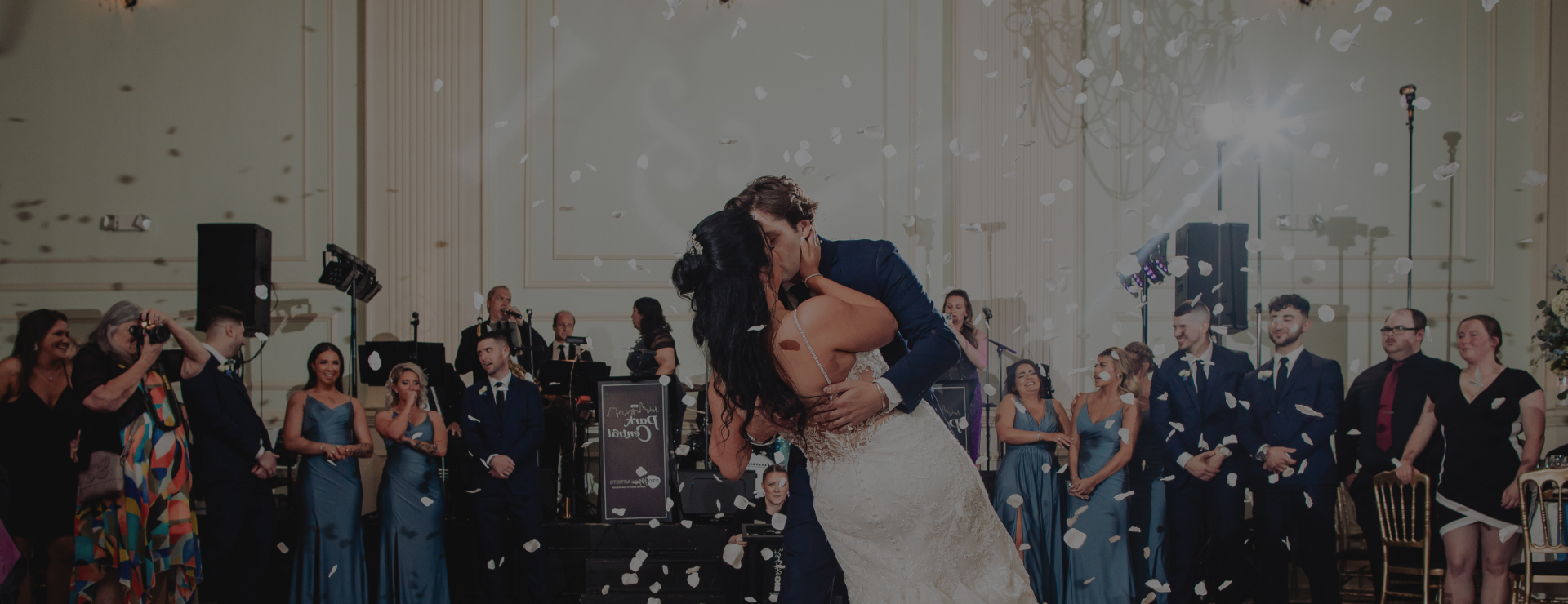
Wedding Band vs. DJ: How to Choose
A live band gives you spectacle and a room that responds in real time. A DJ gives you a wider song range, a smaller footprint, and a lower price. The right choice depends on the reception you picture, the crowd you are hosting, and where your budget needs to go.
Most couples in the Philadelphia area weigh these two options early, before the rest of the entertainment budget is spoken for. We have booked both for more than 10,000 events since 1997, so here is an honest, side-by-side look at how a band and a DJ really differ on the things that decide a reception: energy, song range, cost, space, and the moments you will remember.
Wedding Band vs. DJ at a Glance
Start with the big picture, then read on for the detail behind each row.
| Live Band | Wedding DJ | |
|---|---|---|
| Energy | Live spectacle, a group feeding off the room and reading the floor in real time | Steady, seamless energy with no gaps between songs |
| Song range | A deep, rehearsed repertoire delivered live | A near-unlimited catalog, played as the original recordings |
| Cost, national average | Around $4,500 | Around $1,800 |
| Space and power | A stage area, more power, and load-in and sound-check time | A compact footprint and a fast setup |
| Personalization | Live arrangements, and can often learn a first dance | Exact original tracks and instant genre changes |
| Best for | Couples who want live performance and a show | Couples who want range and value |
The cost figures are national averages from The Knot 2026 Real Weddings Study. Your real number depends on the choices below.
Energy and How the Room Responds
This is the biggest difference, and it is the one guests feel. A live band is a performance. When a horn line kicks in or a singer steps to the front of the stage, people look up, and a good bandleader reads a half-empty floor at 9:40 and reworks the setlist on the spot to fill it. The energy runs both ways. The band feeds off the crowd and the crowd feeds off the band.
A DJ delivers a different kind of energy, steady and seamless. No breaks between songs, no gaps to cover. For a crowd that wants wall-to-wall dancing with no pauses, that continuity is a genuine strength. Our wedding DJs mix live and read the floor the same way a bandleader does, just with a different set of tools.
Song Range and Versatility
A DJ wins on raw range. Almost any song ever recorded is on the table, in the exact version your guests know, and a DJ can jump from a 1960s soul cut to a current pop hit in a single beat. That flexibility is hard to match.
A band answers with something a recording cannot give you: the song performed live, in the room, a little different every time. A strong wedding band carries a deep repertoire across decades and genres, and the live version of a song people love often lands harder than the record. Browse our live wedding bands to hear how wide that range runs, from CTO Tribeca (Party of a Lifetime) to CTO Soul Collective.
What Each One Costs
A band costs more. The Knot puts the national average at $4,500 for a live band against $1,800 for a DJ, and the gap is not arbitrary. A DJ is one professional with a rig. A band is a group of musicians, each of them paid, plus the gear and crew to run it.
What drives your real number is similar for both: how long they play, travel, and extras like additional lighting or sound. For a band, the size of the lineup is the biggest lever. See our wedding band and DJ pricing for how a quote comes together.
Space, Power, and Logistics
A band needs room. A stage or a cleared floor area, more power, and time to load in and sound check before guests arrive. In a smaller venue, that footprint matters, so it is worth checking with your venue early. A DJ needs a fraction of the space and sets up fast. If your reception room is tight, or your guest count is on the smaller side, the practical edge goes to the DJ.
The Moments That Matter
Think about your first dance and your key songs. A DJ can play the exact original recording, which some couples want down to the note. A band can learn that song and perform it live, and can stretch or trim a moment as the room calls for it. Either way you are covered on the details, because both a bandleader and a DJ can act as your MC, handling introductions and announcements and keeping the timeline moving with your planner, photographer, and caterer.
When a Band Makes Sense, and When a DJ Does
A Band Is the Better Fit When
- You want live performance and a visual centerpiece for the reception
- Your guest list spans several generations and you want a group that reads the room
- Your venue has the space and your budget has the room
A DJ Is the Better Fit When
- You want the widest possible song range in the original versions
- Your space is tight or your guest count is smaller
- You would rather put more of the budget toward other parts of the day
Why Not Both: The Fusion Option
You do not have to choose. A Fusion setup combines a live band and a DJ into one seamless experience, so the DJ covers the band's breaks and the music never stops, and a live sax or percussion player can add texture over a DJ track. It is the range of a DJ with the spectacle of a band. Ask us about a custom entertainment setup built around your reception.
See Them Both Before You Choose
The fastest way to decide is to watch. CTO hosts live showcases through the year where you can see our bands and DJs perform before you commit. Read through our FAQ for the common questions, then start your planning form and we will help you land on the right fit for your date and venue.
Frequently Asked Questions
Is a band or a DJ better for a wedding?
Neither is better across the board. A band brings live energy and spectacle. A DJ brings a wider song range, a smaller footprint, and a lower cost. The right pick depends on your reception, your crowd, and your budget.
Is a wedding band worth the cost over a DJ?
For couples who want live performance as the centerpiece, yes. The Knot puts a band around $4,500 and a DJ around $1,800. You are paying for a group of professional musicians and the show they put on. If range and value matter more, a DJ is the smarter spend.
Can you have both a band and a DJ?
Yes. A Fusion setup combines a live band and a DJ so the music runs without a break and you get the strengths of both. We can build one around your reception.
Which is better for a smaller wedding?
A DJ often suits a smaller or tighter space, since the footprint is compact and setup is fast. That said, a smaller band or ensemble can still work beautifully. Tell us your venue and guest count and we will advise.
Do bands and DJs take song requests?
Both can. A DJ can pull almost any recorded track on the spot. A band works from a rehearsed repertoire and can often learn a special request like a first dance if you ask early.
Which needs more space and setup time?
The band. It needs a stage or cleared area, more power, and load-in and sound-check time. A DJ sets up quickly in a compact space.
How far in advance should we book either one?
Nine to twelve months for a peak-season Saturday, and earlier for a date in high demand. Once your venue is booked, lock in your entertainment.